



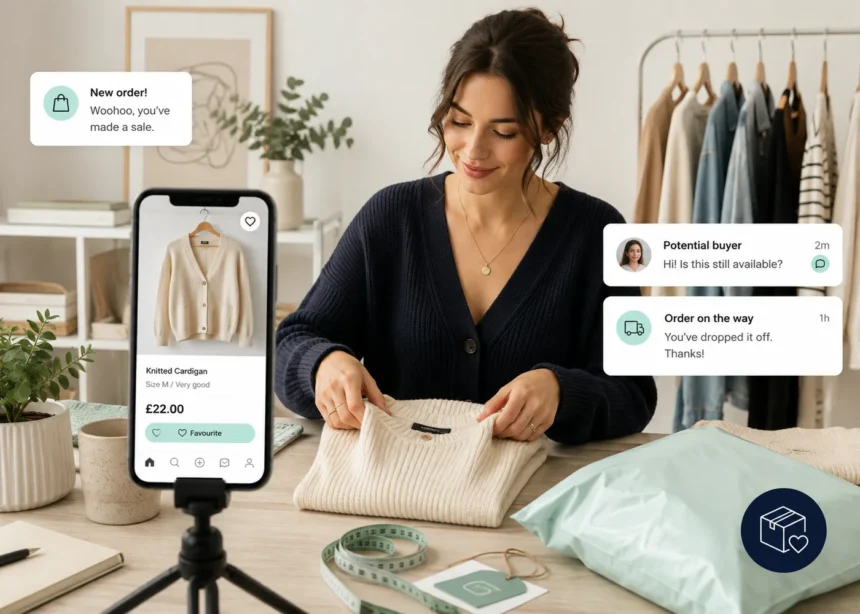
Selling on Vinted looks easy because the mechanics are easy: take photos, write a title, set a price and wait for a buyer. Selling consistently is harder. The difference is rarely one secret “algorithm trick”. It is usually the combined effect of inventory choice, search relevance, first-photo quality, pricing, trust, offer strategy and how efficiently you keep good stock entering the marketplace.
- What Actually Makes an Item Sell on Vinted?
- How Vinted Search and Recommendations Actually Work
- Start With Inventory That Has a Reason to Sell
- How to Take Vinted Photos That Earn the Click
- How to Write a Vinted Title That Matches Buyer Intent
- Write Descriptions for Conversion, Not Decoration
- How to Price Items on Vinted
- Use Favourites as a Pricing Signal
- Bundles Can Improve the Economics of Low-Value Items
- Should You List Every Day? What We Know About Timing
- Do Bumps and Paid Visibility Work?
- Trust Converts Browsers Into Buyers
- Condition and Authenticity Are Sales Tools, Not Administrative Fields
- Diagnose a Slow Listing Before You Discount It
- Build a Repeatable Vinted Listing Workflow
- A 30-Day Vinted Optimisation Test
- Individual Seller vs Vinted Pro: Know the Difference
- Taxes and DAC7: What EU Sellers Should Know
- 12 Mistakes That Reduce Vinted Sales
- The Vinted Seller Strategy in One Page
- Frequently Asked Questions
- Sources & Methodology
That distinction matters more as Vinted grows. Vinted Group reported €10.8 billion in marketplace GMV in 2025, up 47% year on year, with €1.1 billion in revenue. Fashion remained core to the marketplace, while Vinted also expanded further into categories such as sports and collectables. More demand is good for sellers — but more listings also mean more competition for attention.
Source: Vinted Group 2025 Annual Results.
This guide focuses on what a seller can actually control. It combines Vinted’s current selling rules and help documentation with information published by Vinted’s own engineering team about search and recommendation systems. Where sellers commonly speculate — for example about “best posting times” or hidden visibility penalties — we separate evidence from anecdote.
If you are approaching resale as a broader business rather than simply clearing your wardrobe, read How to Start a Secondhand Clothing Business: Costs, Sourcing & Profit Margins. If you plan to source inventory in bulk, our guide to how used clothing wholesale works explains grades, boxes, bales, pallets and landed cost.
KEY TAKEAWAYS
- There is no reliable public evidence of one magic Vinted algorithm hack. Search and recommendations use multiple signals, including item metadata, user behaviour and personalised relevance.
- The first photo earns the click. The title, category, brand, size, colour and description help the listing match buyer intent and filters.
- Price against the buyer’s total cost, not your emotional valuation. Shipping and buyer-side fees can make a near-retail asking price unattractive.
- Favourites are useful diagnostic data. Many favourites with no purchase often suggest price or decision friction; views without favourites often point to the item, presentation or value proposition.
- Upload regularly, but do not build your business around timing folklore. Vinted itself recommends regular uploads; specific “best hours” are market-dependent and not an official ranking rule.
- If you are selling commercially, use the correct account structure. Individual accounts are not intended for commercial resale activity, and Vinted Pro availability varies by market.
What Actually Makes an Item Sell on Vinted?
A Vinted sale requires several things to happen in sequence: the right buyer must discover the listing, choose to open it, trust it, accept the price and complete the transaction.
This means “more views” is not the same goal as “more sales”. A listing can fail at several different stages.
THE VINTED SALES FUNNEL
Sale probability = demand fit × discoverability × click-through × conversion × trust
This is an editorial framework, not Vinted’s ranking formula. It is useful because each stage can be diagnosed separately.
| Problem | Likely bottleneck | What to test first |
|---|---|---|
| Almost no views | Demand, search relevance, category fit or marketplace visibility | Title, metadata, category, season, brand demand |
| Views but few favourites | First impression or weak value proposition | First photo, condition, style appeal, asking price |
| Many favourites but no sale | Price or buyer hesitation | Offer, price reduction, measurements, missing information |
| Messages but no checkout | Decision friction | Answer speed, sizing clarity, shipping options, negotiation |
| Sales but weak profit | Bad unit economics | Acquisition cost, pricing floor, labour per listing |
The biggest advantage of thinking this way is that you stop changing everything at once. If a listing has plenty of views and favourites, rewriting the title may not be the highest-value intervention. If it has no impressions at all, taking ten more detail photos probably will not solve the first problem.
How Vinted Search and Recommendations Actually Work
Vinted does not publish a simple seller-facing ranking formula. What it does publish shows that discovery is heavily data-driven and personalised.
Vinted’s engineering team has described a recommendation system that uses listing information such as brand, price, size and photos, while user-side signals include historical interactions such as clicks, favourites and purchases. The system uses these signals to estimate which listings are most relevant to an individual user.
Source: Vinted Engineering — personalised second-hand recommendations.
Search is equally sophisticated. Vinted moved its large-scale search infrastructure to Vespa, and by late 2024 its searchable index had reached one billion documents. In 2026, Vinted said more than 20% of search sessions started with a click on an autocomplete suggestion. Its suggestion system draws candidates from both product metadata — such as category, colour, brand and attributes — and real search queries.
Source: Vinted Engineering — personalised search autocomplete.
WHAT VINTED’S OWN ENGINEERING DATA TELLS SELLERS
The practical implication is straightforward: help Vinted understand exactly what the item is, and help the buyer recognise immediately that it matches their intent.
There is also an important reason not to obsess over one supposed algorithm trick. Personalisation means two buyers can be shown different items because their sizes, categories, clicks, favourites and purchase histories differ. Your listing does not have one universal rank.
Do not try to “beat the algorithm”. Make the item easy for the marketplace to classify and easy for the right buyer to choose.
Start With Inventory That Has a Reason to Sell
No listing optimisation can manufacture strong demand for every garment. Before changing photos, titles or prices, ask whether the item has a clear buyer.
Demand on Vinted is fragmented. Brand, category, size, season, style, condition and market all matter. A basic coat can become highly relevant in October and nearly invisible in May. A specific trainer model can have search demand that a generic unbranded shoe does not. Children’s clothing may have lower unit prices but stronger bundle economics.
Use Vinted itself as your research tool:
- search the exact brand and item type;
- use relevant category, size, condition and colour filters;
- look at how much comparable supply exists;
- compare the presentation and asking prices of alternatives;
- watch autocomplete suggestions to understand the language buyers use;
- check whether the item is seasonal or trend-dependent;
- compare your item with what a buyer can purchase new at retail or in current sales.
Autocomplete is particularly useful because Vinted says its suggestion candidates incorporate both product metadata and real user search behaviour. That does not give you exact search volume, but it can help you use buyer language instead of seller jargon.
INVENTORY FIRST
A weak item with perfect optimisation is still a weak item. If you are buying specifically for resale, purchasing discipline will influence your Vinted results more than any posting trick.
How to Take Vinted Photos That Earn the Click
The first photo has one job: make the right buyer stop scrolling and open the listing. Additional photos then remove uncertainty.
Vinted’s current Catalog Rules require listing photos to represent the actual item, be sharp and clear, be taken by the seller for the listing, and not be replaced with stock, advertisement or watermarked images. Vinted also says the first photo should clearly represent the whole item, and sellers can upload up to 20 images per listing.
Official rules: Vinted Catalog Rules.
The first photo
- Show the whole garment clearly.
- Use uncluttered surroundings.
- Use bright, even light so the colour and condition are readable.
- Make the item occupy enough of the frame to be legible on a phone.
- Avoid props that compete with the garment.
- Do not hide flaws through angles, filters or editing.
A neutral background is not an algorithm requirement. It is a conversion tool. It makes the garment easier to understand in a crowded feed.
The supporting photos
A useful sequence for clothing is:
| Photo | Purpose |
|---|---|
| 1. Full front | Earn the click and identify the product. |
| 2. Full back | Show the full design and silhouette. |
| 3. Brand label | Confirm brand and support authenticity. |
| 4. Size / composition label | Reduce sizing and material questions. |
| 5. Construction / detail | Show texture, print, hardware or distinguishing features. |
| 6+. Defects | Document wear, stains, repairs or damage clearly. |
| Optional measurements | Photograph a tape measure if dimensions are important. |
For branded items, Vinted specifically recommends clear photographs that demonstrate authenticity. Depending on the category, that can include labels, logos, serial information, stitching, packaging or other identifying details.
Official guidance: Vinted — How to take photos of branded items.
IMPORTANT
Do not “improve” listing photos with generative AI, replacement backgrounds, colour manipulation or edits that change how the item appears. Vinted’s Catalog Rules state that listing pictures must represent the item as it is and that image editing is not allowed.
How to Write a Vinted Title That Matches Buyer Intent
A good title describes the item in the language a buyer is likely to search. It should be specific, factual and free from irrelevant keyword stuffing.
Vinted’s own guidance recommends specific details such as brand, colour, item type or unique features and advises against vague words that do not distinguish the item.
Official guidance: Vinted — Describing an item.
PRACTICAL TITLE STRUCTURE
Brand + item type + defining feature + colour / model where useful
| Weak title | Stronger title |
|---|---|
| Beautiful jacket | Levi’s oversized denim trucker jacket blue |
| Nice Zara dress | Zara black satin midi slip dress |
| Nike shoes | Nike Air Force 1 white leather trainers |
| Vintage top | Vintage 90s striped cotton polo shirt |
Do not add unrelated brands hoping to appear in more searches. Vinted’s Catalog Rules prohibit using unrelated brands in the title, description or hashtags, and “inspired by [brand]” language can also violate its intellectual-property rules.
Search optimisation on Vinted is therefore not about stuffing every trend word you know. It is about accurately connecting the item to the searches where it genuinely belongs.
Write Descriptions for Conversion, Not Decoration
A good description answers the questions that would otherwise stop the buyer from checking out.
For most clothing listings, that means:
- exact item type;
- brand;
- tagged size;
- how the fit compares with the tagged size if genuinely useful;
- material;
- colour;
- condition;
- specific defects;
- relevant measurements;
- distinctive features such as cut, print, fastening or collection.
Vinted requires sellers to choose the true condition and describe defects, alterations or missing parts. If an item is significantly not as described, the buyer may be able to return it for a refund.
Official guidance: Vinted — Choosing item condition.
EXAMPLE DESCRIPTION
Levi’s blue denim trucker jacket, size M. Mid-weight non-stretch denim with button front and two chest pockets. Very good used condition. Light fading at the cuffs and collar shown in photos; no holes or stains. Approx. pit-to-pit 55 cm, back length 64 cm.
Short, factual and decision-oriented. The goal is not creative copywriting — it is confidence.
Also remember that Vinted prohibits listing and profile descriptions from containing references or links to external websites or platforms, subject to narrow exceptions described in its rules. Do not try to funnel buyers to your own store from an ordinary listing.
How to Price Items on Vinted
The best Vinted price is not the highest price you can justify. It is the price that produces the best combination of margin and realistic sell-through.
A common pricing mistake is to anchor too strongly to original retail price. Buyers do not evaluate only your item price. Their checkout cost can also include shipping and buyer-side protection charges, depending on market and transaction type. That means a €40 secondhand item can compete poorly with a €50 new item if the retailer offers a promotion, free delivery or easier returns.
Vinted itself tells sellers to insert a competitive price when listing an item. See Vinted — Uploading an item step by step.
Use three prices, not one
PRICING FRAMEWORK
Floor price — the lowest price you are willing to accept.
Target price — the price that gives you the return you actually want.
Listing price — the asking price, which can leave sensible room for negotiation.
For a casual seller clearing personal items, the floor price may simply be the minimum amount worth the effort. For a reseller, the floor must account for acquisition cost, cleaning, packaging, labour and required margin.
If you buy specifically for resale, calculate this before you purchase the item:
RESELLER FLOOR
Minimum acceptable sale price = inventory cost + variable processing cost + required contribution
For more detailed secondhand unit economics, see our guide to secondhand clothing costs, margins and stock turnover.
Use Favourites as a Pricing Signal
A favourite is not a promise to buy, but it is useful information. It tells you that at least one buyer found the item interesting enough to save.
Vinted says that when another member favourites your item, you receive a notification and can open the conversation and make an offer. Vinted also notifies users when the price of a favourited item is reduced.
Official guidance: Vinted — Favourites and Vinted — Notifications.
| Signal | Possible interpretation | Sensible next step |
|---|---|---|
| 0–few views | Weak discoverability or demand | Review category, title, metadata and season before cutting price aggressively. |
| Views, no favourites | Item is seen but not compelling | Test the first image and value proposition. |
| Many favourites, no offers | Interest exists but price or uncertainty blocks action | Add missing information or test a modest reduction. |
| Favourites plus repeated low offers | Market may be signalling a lower clearing price | Compare offers with your floor and competing supply. |
Do not automatically message every favourite with an aggressive sales pitch. An offer can be useful, but a high-volume stream of unsolicited messages can feel transactional. Use the tool selectively where the economics justify a discount.
Bundles Can Improve the Economics of Low-Value Items
Bundles are particularly useful when one item is too cheap to justify the buyer’s shipping cost on its own.
Vinted allows sellers to set discounts for buyers purchasing multiple items, and the platform itself recommends bundle discounts as a way to encourage more sales. Buyers can also combine eligible listings from the same seller into a bundle, reducing shipping friction.
Official guidance: Vinted — Selling your items faster.
Bundles are most effective when the wardrobe has enough logical cross-sell:
- several items in the same size;
- children’s clothing grouped around an age range;
- similar style or season;
- several low-ticket basics;
- complementary pieces that appeal to the same buyer.
A wardrobe with 100 unrelated items can have less bundle potential than a wardrobe with 30 pieces aimed at one clearly defined buyer profile.
Should You List Every Day? What We Know About Timing
Vinted officially recommends uploading items regularly. It does not publish a universal “best time to post” rule.
Vinted says regular uploads can help sellers gain followers and that followers may be notified when a seller lists new items. Its own recommendation systems are also updated to include new and changed listings, and its search infrastructure is designed for real-time updates.
What Vinted does not publicly say is that everyone should list at 7 p.m., wait exactly 20 minutes between listings, or post only on Sundays. Community discussions regularly report different “best” times and highly variable visibility. Those observations may be locally useful, but they are not evidence of a stable platform-wide ranking rule.
A BETTER APPROACH
Use a consistent listing cadence that fits your workload, then test timing against your own market. Do not reorganise your entire operation around unverified algorithm folklore.
If you have 30 items ready, you can test two approaches over several weeks: concentrated listing sessions versus steady daily uploads. Compare views, favourites and sales by item quality and category. The point is to measure your own wardrobe rather than inherit somebody else’s anecdote.
Also avoid maintaining duplicate active listings. Vinted’s Catalog Rules state that each item should have only one listing.
Do Bumps and Paid Visibility Work?
Paid visibility can increase exposure, but it cannot repair a weak product-market fit.
Vinted says item Bumps can make listings more visible in members’ Newsfeeds. That makes Bumps a distribution tool, not a guaranteed sales tool.
Official guidance: Vinted — Selling your items faster.
Use paid visibility only after the listing has passed a basic quality check:
- the item has credible demand;
- the first photo is strong;
- the title and metadata are accurate;
- the condition is clearly represented;
- the asking price is competitive;
- the likely contribution justifies the promotion cost.
PAID VISIBILITY TEST
If an item makes €4 contribution at your target sale price, spending €2 to promote it consumes half of that contribution. If a €100 item has €40 contribution, the same promotional cost has a very different economic meaning.
Measure promotion on profit, not just extra views.
Trust Converts Browsers Into Buyers
Vinted buyers make decisions with incomplete information, so trust reduces transaction friction.
Vinted recommends profile verification, completing the About me section, good communication, accurate listings and clear photos as trust-building measures. See Vinted Trust & Safety.
For sellers, trust is created by small operational details:
- describe defects before the buyer asks;
- use consistent, original photos;
- answer sizing questions clearly;
- respond to sensible questions without unnecessary delay;
- package the item securely;
- ship within the platform’s stated deadline;
- avoid arguments over minor negotiations;
- build feedback through reliable transactions.
Trust becomes even more important as price rises. A €5 children’s T-shirt requires little deliberation. A luxury bag requires evidence of authenticity, detailed condition photography and a seller profile that does not create unnecessary doubt.
Condition and Authenticity Are Sales Tools, Not Administrative Fields
Accurate condition protects the transaction and can also make the listing easier to buy.
Vinted’s condition options distinguish between new, like new, very good, good and satisfactory items, with definitions that vary slightly by product category and market. Vinted advises sellers to choose a poorer condition when in doubt and to photograph and describe flaws.
Do not assume that selecting the highest possible condition increases conversion. If the photographs reveal obvious wear that conflicts with “Like new”, the listing creates distrust before purchase and dispute risk after purchase.
Counterfeit items are prohibited. Vinted states that sellers should list branded goods only when they are sure the item is authentic; disclaimers such as “I don’t know if it’s real” do not solve the problem.
Official rules: Vinted Catalog Rules.
Diagnose a Slow Listing Before You Discount It
Do not lower the price automatically every time an item fails to sell quickly. Diagnose what the available signals are telling you.
| Listing behaviour | First test | Second test | Do not assume |
|---|---|---|---|
| No views | Search/category relevance | Season and demand | That price is definitely the only problem |
| Views but no favourites | First image | Price/value | That more keywords will fix it |
| Favourites but no sale | Price / offer | Measurements or uncertainty | That favourites guarantee a sale |
| Repeated questions | Description | Missing photos | That buyers are simply difficult |
| Repeated low offers | Market clearing price | Alternative sales channel | That every buyer is a lowballer |
| Fast sale immediately after upload | Check whether you underpriced | Record the category/brand | That every future item will sell as fast |
The last row is important. Sellers often celebrate an instant sale without asking whether the item was priced far below demand. Fast turnover is valuable, but so is learning where you left too much margin on the table.
Build a Repeatable Vinted Listing Workflow
For anyone selling more than a handful of items, workflow efficiency becomes part of profit.
A strong operating sequence is:
THE VINTED SELLER WORKFLOW
1. Inspect before photography
Find defects first. Otherwise you may finish a listing and discover later that the sleeve has a stain you never photographed.
2. Batch similar tasks
Photograph ten garments in one setup instead of rebuilding your photo station ten times. Measure them together. Then write listings from a prepared dataset.
3. Store inventory so it can be found
A sale is not complete until the item is shipped. If 300 listings are stored randomly, fulfilment time can erase much of the efficiency gained during listing.
Simple SKU logic can help: for example, box A03 / item 17. The buyer never needs to see your internal SKU if the platform does not provide a dedicated field; the point is that you can locate the garment quickly.
4. Track decisions, not vanity metrics
For each category or sourcing batch, record:
- purchase cost;
- listing date;
- asking price;
- actual sale price;
- days to sale;
- offers received;
- processing time;
- markdowns;
- final contribution.
That dataset tells you what to buy again. Views alone do not.
A 30-Day Vinted Optimisation Test
If your wardrobe feels random, use 30 days to turn it into an experiment.
| Week | Action | What you learn |
|---|---|---|
| Week 1 | List 10–20 items using one consistent photo and title standard. | Your baseline views, favourites and conversion. |
| Week 2 | Improve first photos and missing descriptions on weak listings. | Whether presentation is the bottleneck. |
| Week 3 | Test modest price changes and targeted offers on high-interest listings. | How price-sensitive your buyers are. |
| Week 4 | Compare categories, brands, sizes, acquisition cost and time to sale. | What inventory deserves more capital. |
Do not change the photo, title, price and description of every item on the same day if you want to learn what mattered. Controlled changes create useful information.
THE GOAL
At the end of 30 days, you should know which items generate demand, which listings convert, what your realistic sale prices are and which stock you should stop buying.
Individual Seller vs Vinted Pro: Know the Difference
If you are buying stock specifically to resell regularly for profit, do not assume an ordinary personal Vinted account is automatically appropriate.
Vinted’s Catalog Rules state that commercial activity is not allowed for individual users. The criteria Vinted may consider include large transaction volumes, selling items purchased in bulk, selling items bought with the intent to resell, repeated sales intended to generate regular income or profit, and operating as a business.
At the same time, Vinted operates Vinted Pro for professional sellers in supported markets. Its current Help Centre says the service is available to eligible sellers registered in France, Italy, the Netherlands, Luxembourg, Belgium, Portugal, Spain, the UK, Ireland, Germany and Austria, while availability can also appear in other countries through testing.
Official information: Vinted Pro service.
Availability and account requirements change by market. If you qualify as a professional seller but Pro is not available where you are registered, do not try to disguise commercial activity as casual wardrobe clearing. Check Vinted’s current local terms and choose a marketplace structure that allows your business model.
Pro sellers also have consumer-law obligations that casual C2C sellers do not. For example, Vinted states that eligible Pro transactions include a consumer right of withdrawal, subject to applicable exceptions.
BUSINESS SELLER NOTE
This article is a marketplace strategy guide, not legal or tax advice. Whether your activity legally constitutes a business depends on the facts and the law of your country — not only on what your Vinted profile says.
Taxes and DAC7: What EU Sellers Should Know
DAC7 is a platform reporting regime; it does not create a new tax on Vinted sales.
The EU’s DAC7 rules require qualifying digital platforms to collect and report information about reportable sellers and relevant platform income to tax authorities. The European Commission explicitly states that DAC7 does not impose a new tax and that income remains taxable according to the national rules of the seller’s country.
Official source: European Commission — DAC7.
Under the current DAC7 framework for sales of goods, the reporting exclusion applies to sellers with fewer than 30 transactions and no more than €2,000 of consideration in a calendar year. In June 2026, the European Commission proposed changing that threshold as part of a tax-simplification package, including removing the transaction-count threshold and increasing the monetary threshold. At the time this guide was reviewed, that change was a proposal rather than a reason to assume the current rules had already disappeared.
Most importantly, a platform reporting threshold is not the same thing as a tax-free allowance. A seller can have taxable business income below a reporting threshold, or non-taxable private disposal above one, depending on national law and the facts.
12 Mistakes That Reduce Vinted Sales
1. Using a weak first photo
If buyers cannot understand the item in a fraction of a second, fewer will open the listing.
2. Writing vague titles
“Lovely top” communicates almost nothing to search or to a buyer with specific intent.
3. Keyword stuffing unrelated brands
It reduces listing quality and can breach Vinted’s Catalog Rules.
4. Hiding flaws
Short-term conversion is not worth increased return, dispute and feedback risk.
5. Pricing from original retail alone
The buyer compares your total transaction cost with current secondhand supply and current retail alternatives.
6. Automatically accepting every low offer
Know your floor price before negotiation begins.
7. Automatically rejecting every low offer
Repeated market feedback can reveal that your valuation is the problem.
8. Buying too much slow stock
A wardrobe full of unsold inventory is not evidence of a scalable resale business.
9. Paying to promote a weak listing
More exposure simply shows the same weak offer to more people.
10. Believing one algorithm theory explains everything
Personalised ranking, search demand, category competition, season and item quality all interact.
11. Treating listing time as free
For a reseller, five minutes of photography and listing time has an economic cost. Low-value items need efficient workflows or bundle economics.
12. Using an individual account for a commercial model
Account structure and local legal status should match the reality of your activity.
The Vinted Seller Strategy in One Page
If you want a simple operating system, use this:
- Source: choose inventory with identifiable demand and enough margin.
- Inspect: find defects before listing.
- Photograph: make the whole item obvious in image one; document condition and authenticity afterward.
- Classify: choose accurate category, brand, size, colour, condition and attributes.
- Title: describe the item using specific buyer language.
- Describe: remove uncertainty with material, fit, measurements and flaws.
- Price: define floor, target and listing price using competitive supply and buyer total cost.
- Publish: upload consistently rather than waiting for a mythical perfect minute.
- Convert: use offers, price reductions, bundles and communication where they make economic sense.
- Analyse: separate visibility problems from conversion problems.
- Fulfil: find, pack and ship efficiently.
- Repeat: buy more of what sells profitably, not simply what receives views.
The best Vinted strategy is not to maximise listings. It is to maximise the number of good purchasing decisions that become profitable, low-friction sales.
For the wider economics behind sourcing, stock turnover and contribution margin, continue with How to Start a Secondhand Clothing Business. For bulk inventory, read How Used Clothing Wholesale Really Works. You can also explore the Marketplaces section for future marketplace-specific guides.
Frequently Asked Questions
How can I sell faster on Vinted?
Start with a competitive item, use a clear original first photo, write a specific title, select accurate metadata, disclose condition honestly and price against comparable supply and the buyer’s total transaction cost. Vinted also recommends regular uploads, bundle discounts, offers to interested buyers and profile verification.
How does the Vinted algorithm work?
Vinted does not publish one simple ranking formula. Its engineering team describes personalised search and recommendation systems using listing metadata, photos, brand, price and size alongside user interactions such as clicks, favourites and purchases. Search suggestions also use product metadata and aggregated real search queries.
What is the best time to post on Vinted?
Vinted recommends uploading regularly but does not publish one universal best posting time. Seller communities report different results by country, day and season, so test timing using your own listings rather than treating one hour as an algorithm rule.
Should I lower the price if an item has many favourites?
Not automatically. Multiple favourites indicate interest, but no purchase may suggest price friction or missing information. Compare the item with competing listings, check your minimum acceptable price and consider a targeted offer or modest reduction. Vinted notifies users when a favourited item’s price is reduced.
Should I message people who favourite my Vinted item?
Vinted allows sellers to open the favourite notification and send an offer. Use this selectively. A relevant discount can convert genuine interest, but repeatedly messaging every person who favourites an item is not necessary.
How many photos should I use on Vinted?
Use enough photos to remove meaningful uncertainty. Vinted currently allows up to 20 photos per listing and requires the first image to clearly represent the item. Clothing listings normally benefit from full front and back images, labels, material/size information, important details and every material defect.
Can I use stock photos on Vinted?
No. Vinted’s Catalog Rules require photos taken by the seller for the listing and prohibit replacing them with stock, advertising or watermarked images. The pictures must represent the actual item.
Do hashtags help Vinted listings?
The safest strategy is accurate language, not hashtag stuffing. Vinted prohibits unrelated brand names in titles, descriptions and hashtags. Its own search systems use structured metadata and real query language, so relevance matters more than adding unrelated popular terms.
Are Vinted Bumps worth paying for?
They can increase visibility, but profitability depends on the item. Test paid promotion only after the photo, price, title and product-market fit are strong, and compare the promotion cost with the contribution you expect from the sale.
Can I buy clothes wholesale and resell them on a normal Vinted account?
Vinted’s Catalog Rules say individual accounts are not intended for commercial selling and specifically identify bulk purchasing and buying items with the intent to resell as indicators of commercial activity. Professional sellers should check whether Vinted Pro is available and appropriate in their registration country.
Sources & Methodology
This guide prioritises current Vinted rules, Help Centre documentation and engineering publications over third-party claims about the marketplace algorithm. Community discussions were reviewed to identify common seller questions and anecdotal theories, but unsupported timing or ranking claims are not presented as platform facts.
- Vinted Group 2025 Annual Results — GMV, revenue, profitability and marketplace expansion.
- Vinted Catalog Rules — listing, photography, authenticity, duplicate listing and commercial-activity rules.
- Vinted — Uploading an item step by step — current listing workflow.
- Vinted — Describing an item — title and description guidance.
- Vinted — Choosing item condition — condition definitions and defect disclosure.
- Vinted — Selling your items faster — bundles, Bumps, offers, regular uploading, trust and shipping options.
- Vinted — Favourites — seller notifications and offers to interested buyers.
- Vinted — Notifications — price-drop and listing notifications.
- Vinted Engineering — Personalised Search Autocomplete — search queries, metadata, ranking and personalisation.
- Vinted Engineering — Personalised Recommendation Retrieval — listing and user signals used in recommendation retrieval.
- Vinted Engineering — Billion-Scale Search — scale of Vinted’s search index.
- Vinted Pro service — professional seller eligibility and current market availability.
- European Commission — DAC7 — digital platform reporting rules and distinction between reporting and taxation.
- Secondhand Business — How to Start a Secondhand Clothing Business — inventory economics, margins and stock turnover.
- Secondhand Business — How Used Clothing Wholesale Really Works — sourcing, grades and wholesale inventory economics.
EDITORIAL NOTE
Vinted features, fees, categories, shipping options and Pro availability differ by country and can change over time. This guide uses current public Vinted documentation available in August 2026 and focuses on principles that remain useful across markets. Always check the Terms, Catalog Rules and Help Centre for the country in which your account is registered.
Data and platform documentation reviewed: August 2026. Search and recommendation systems are continually tested and updated. No third party can guarantee ranking, reach, views or sales from a particular listing technique.